
Twenty AI pilots. And on Monday everything runs as before.
The routine no pilot replaces. What is missing between twenty demos and a number for the board: an owner, a cadence, and one line with before and after.

The routine no pilot replaces. What is missing between twenty demos and a number for the board.
Sunday evening. The deck for Tuesday lies open on the kitchen table, and you are on the slide with the adoption curve. It points up. Licences active, users per week, queries per day. A good slide. You signed it off yourself.
Then you hear the question before anyone asks it. You know the voice; on Tuesday it sits to your left, and it always asks the same thing: “And what has actually changed?”
You flip back. Twenty pilots this year. The contract review that now goes faster. The month-end close someone lets a model comment on. The natural-language queries that drew applause in steering. All there. What is not there: a single line with before and after, a name and a date. You close the deck and know that on Tuesday you will talk about the curve, because the line is missing.
Why the boat stays in harbour
This is not a finding about your team. It is a finding about a missing cadence.
Your team did what you asked: try, show, learn. In steering, each person in turn presented their pilot, and you nodded at every one because every one was good. The minutes said “keep going”. Then everyone went back to their process, and the process ran as before. Each person owned their experiment. Nobody owned the process. The pattern has a name: diffusion of responsibility instead of ownership. It arises by itself as soon as tools are available to everyone and nobody has decided which process they should change first. The boat is built, the lights on the water are your pilots, and nobody is at the helm.
A pilot has an author. A process needs an owner. Those are almost never the same people, and almost never does the owner stand at the front in steering. Decision-to-Execution, the stretch from decision to effect, starts at exactly this point: with the question of who owns the process, not who masters the tool.
Cadence replaces discipline
I am not saying this from the stands. I work with AI every day – analyses, drafts, research, reviews – and this year I have rebuilt the foundation of my own firm on it. What I chose along the way is in the closing article of my series. While writing that article I noticed the line that is missing for me. I have no routine that takes one process after another, improves it together and then makes sure everyone executes it the improved way. I experiment. The people around me experiment. The process we jointly depend on runs on Monday as it did the Friday before.
I first tried more discipline. Resolutions, reminders, a notebook of improvement ideas. It lasted three weeks. Discipline is individual, a process is shared, and the two do not fit. What holds is a cadence.
The cadence I now run lasts 45 minutes a week, at a fixed slot, and has four steps. An owner chooses a process: small, frequent, with a visible result, close enough that it can run differently next week. The owner executes it with AI for one week and writes the improved execution on one page: what the tool takes over, what the human decides, where the boundary lies. In the 45 minutes the round checks three things: what has changed, how we measure it, at which result we abort. From a fixed date the improved execution applies to everyone, and the old one is retired, not tolerated. Then comes the next process.
If a process shows no measurable change after two rounds, it is set aside and the next one moves up. The pilot is not abolished by this. It has become the entrance to the routine, not its result.
The catch: the first process is small
I hear the objection because I had it myself: “The board does not want to see a small process. It wants the big use case.”
That is true. The board wants the big use case. Only the wild west already produces those – twenty of them, none in operation. What the board does not get on Tuesday is a measured change with owner and date. That is exactly what the first small process delivers. After a quarter there are twelve cadences and, if half of them hold, four to six processes with one number each. That is enough to defend a budget decision, in front of the committee and later in front of audit. With an adoption curve you can only postpone it.
A boundary belongs with this. The cadence does not replace governance for data and AI. It presupposes that the controlled space and the governed fact base are in place. Without both, the routine improves a process on facts nobody will defend. What happens when that sequence is inverted I described in article one of the series.
What do twenty experiments a month cost?
Schluss mit Chef-Lähmung: Dieser Mann macht Entscheide endlich umsetzbar.
Wir verwandeln Entscheidungsstau in klare, belastbare und umsetzbare Entscheidungen.
The first film is your today. Three people each experiment ten days a month with AI, at an internal day rate of CHF 1,500. That is CHF 45,000 a month, as a model calculation, kept deliberately small. The money is not lost; the learning has a value. The value stays with the person and does not migrate into the process. And next year’s budget round rests on a curve that says nothing about effect. A decision postponed or wrongly sized on that basis costs, in regulated houses in my experience, between CHF 200,000 and 2,000,000 a month, depending on the process behind it. It does not hurt like an accident. It pulls, a little, every month.
The second film plays twelve weeks later, at the same kitchen table. In the deck there is a new slide. Four lines, each a process, a name, a date, a number before and after. The adoption curve is still in there, on slide two, as context. The question from the left, from the chair, comes anyway. You answer it with one line.
After a quarter you are not thereby an AI organisation. That would be nonsense. But you have four numbers nobody else in the room has, and a routine that survives a change of tool, vendor and model. Vendors deliver capability, at ever shorter intervals. What becomes of it is decided by the cadence in-house.
The one-process card in five lines
The tool the cadence runs on fits on a card. Five lines, and the first week can start.
- Process. Name, frequency, who executes it today.
- Owner. One name. Not a team, not a committee.
- Improved execution. One page: what AI takes over, what the human decides, where the boundary lies.
- Measurement point. Before and after, in minutes per case, error rate or throughput. Plus a leading indicator: how many people already execute the new way.
- Cutover date and abort criterion. From when the new execution applies to everyone, and at which result we stop.
You do not need a mandate or a budget for this. You need a process that belongs to you, 45 minutes next week and a sentence for the next steering that you can say verbatim: “Which process will run differently from the first of October, and who owns it?” The cadence board on which these cards later converge comes only when the third card is filled in. Before that it would be slide logic.
The process you would name first
My first card is filled in: [PROCESS, decision Adrian], every [WEEKDAY], 45 minutes. In a quarter I will know whether the routine holds, and I will report it here, with the number.
If you are among the people who get the question from the left on Tuesday: which process would you name first? The smallest one that can run differently next week. Write me the name of that process. Not the result, only the name.
Next Sunday the deck will be on the table again. One slide is new. It has five lines, and one of them carries your name.
Über den Autor
Related articles

They did not wait for Rome
14. August 2026

A data product is not a dataset with an owner
9. August 2026

Corporate context does not belong in the prompt.
7. August 2026

The LLM is allowed to respond. It should not decide what is true.
5. August 2026

The Sparkline secret behind every effective speech
2. August 2026
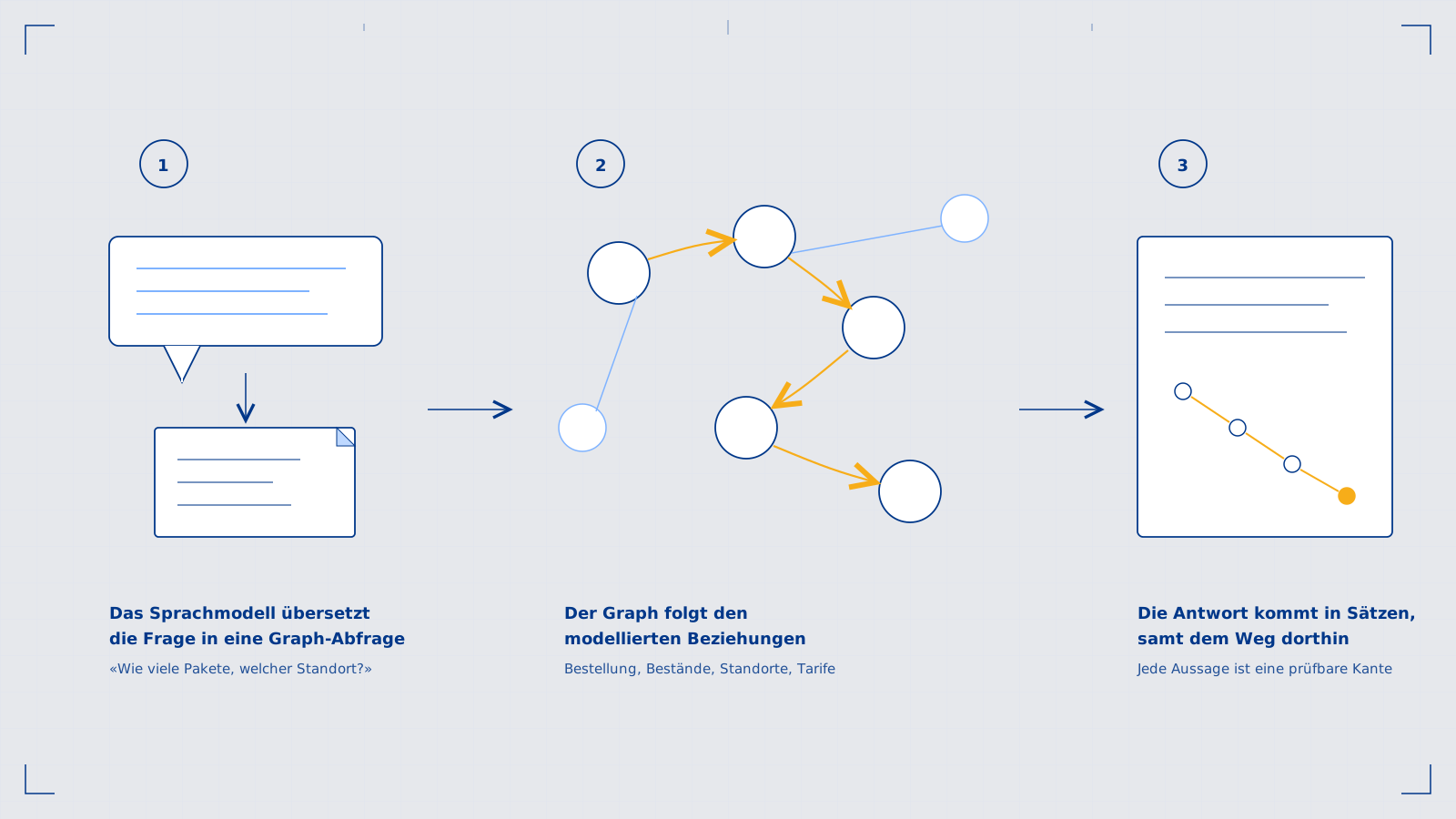
Knowledge Graph in the company: Your data warehouse understands nothing
27. Juli 2026